Spooky Tree Embroidery
First Impression: Eerie, Distinctive, and Booth-Ready
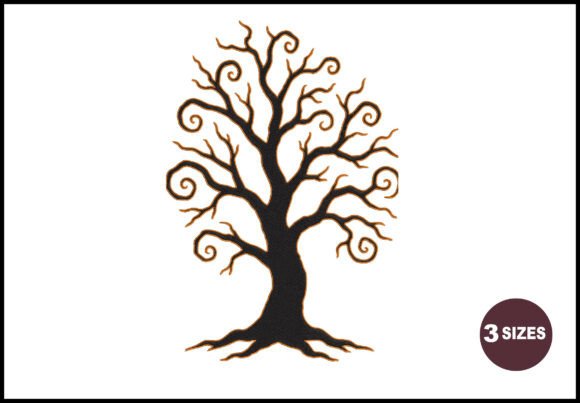
As an embroidery designer who’s prepped over 200 craft fair booths—and shipped thousands of embroidered tote bags, tea towels, and patches—I opened Spooky Tree Embroidery expecting something atmospheric but commercially viable. What I found was a design that lands perfectly between gothic elegance and accessible Halloween charm. It’s not cutesy or cartoonish; it’s spooky and swirly, as the description promises—bare branches curl with intentional motion, suggesting wind, mystery, or quiet haunting. That visual tension makes it stand out instantly on a crowded table display. Customers don’t pause to decode it—they *feel* it. That’s rare. In a sea of pumpkins and bats, Spooky Tree Embroidery reads as premium, intentional, and seasonally versatile—ideal for autumn markets through early November.
Where It Shines: Product-by-Product Realities
Tote bags: A standout. The tree’s vertical silhouette fills a standard 4"–5" hoop beautifully and scales well up to 7" without losing definition. On natural canvas or oat linen, it reads as artisanal—not mass-produced. Pair it with black or charcoal thread for contrast that pops under market tent lighting.
Aprons and tea towel embroidery: Works best as a single focal motif near the pocket or corner—not centered top-to-bottom. Its linear flow complements kitchen textiles without overwhelming them. Avoid dense terry cloth towels unless you use cutaway + tear-away stabilizer combo; fabric texture can swallow fine branch details.
Embroidered patches: Highly effective. At 3.5" tall, the tree retains legibility even when heat-applied to denim jackets or backpacks. Suggest backing with iron-on fusible web *and* stitching the edges for durability—this isn’t a flat geometric shape, so clean perimeter stitching matters.
Caps and curved surfaces: Proceed with caution. The swirling branches rely on smooth stitch directionality. Test on a scrap cap first—especially if using high-crown structured caps. Dense stitch areas near the trunk base may pucker without precise hooping and medium-weight stabilizer.
Pillow covers and small pouches: Ideal scale. At 4"–4.5", Spooky Tree Embroidery anchors the front panel without dominating. Works beautifully on velvet, cotton sateen, or linen-blend fabrics where subtle sheen enhances the “eerie” mood.
Printable mockups and Etsy listings: Photographs exceptionally well. The negative space around the branches gives digital mockups breathing room—no busy backgrounds needed. Use moody, low-saturation lifestyle shots (think foggy porch, antique desk, dim candlelight) to amplify its gothic decor appeal.
Production Practicality: Batch-Friendly, But Not Blindly So
This is a realistic machine embroidery design—not overly technical, but not forgiving of shortcuts either. It’s easy to understand at a glance (no hidden layers or confusing color changes), which speeds up booth prep and team training. As a small accent (2.25"–3"), it works cleanly on collar tabs or pocket corners. As a large focal (6"+), it holds integrity—but only if your hoop size supports it. Check your hoop size before cutting fabric. Also verify stitch density: tight swirls near the base can run hot on commercial machines. If you’re batch-producing 50+ items, run a test on your slowest machine first.
Thread colors matter more here than in simpler designs. Monochrome black works, but deep plum, charcoal grey, or oxidized green adds depth and signals handmade quality. Avoid pastels—they dilute the spook factor.
Careful-Use Notes: Protect Your Profit Margins
- Dense stitch areas: Concentrated near the trunk and root zone—use medium-cutaway stabilizer on lightweight fabrics to prevent puckering.
- Tiny details: Branch tips taper finely. Don’t shrink below 2.5"—clarity degrades fast on textured towels or fleece.
- Dark fabric: Requires high-contrast thread (e.g., silver-grey on navy, white on black). Always test thread visibility under natural light—not just booth LEDs.
- Curved surfaces (caps, pouches): Swirls distort easily. Hoop tightly, reduce speed 20%, and avoid stretchy knits.
- Textured towels: Terry loops trap thread. Use water-soluble topping + cutaway backing, and trim loops *before* hooping.
Booth & Brand Impact: Why This Design Converts
In person, Spooky Tree Embroidery draws attention without shouting. It’s the kind of detail that makes shoppers stop, tilt their head, and say, “Oh—what *is* that?” That micro-moment of curiosity is gold at craft fairs. It reinforces handmade quality because the swirls read as deliberate, not algorithmic. For Etsy sellers and small shop owners, it strengthens brand consistency—pair it across product lines (tote + patch + pillow) and customers recognize your aesthetic instantly. And unlike generic Halloween motifs, it feels repeatable: you can offer it year after year without fatigue, especially when paired with new thread palettes or seasonal fabric choices.
Designer’s Must-Do Checklist Before Selling
- Test the embroidery file on scrap fabric matching your intended product (e.g., canvas for totes, terry for towels).
- Confirm thread contrast under both indoor and outdoor lighting—what looks rich in your studio may fade on a sunlit market table.
- Review spacing between branches—if threads nest too closely, they’ll merge on dark fabric.
- Verify hoop size compatibility—don’t assume it fits your 5x7 if the design spans 6.8".
- Inspect stitch density in the trunk swirls—excessive density risks thread breaks during long runs.
- Use the right stabilizer: cutaway for knits and towels, tear-away for stable wovens like linen or cotton duck.
- Create at least one real-world mockup—not just digital. Drape it on your tote bag sample and walk around your booth space.
- Compare how it reads on light vs. dark fabric swatches—value perception shifts dramatically.
- Confirm commercial licensing applies to finished products before listing on Etsy or wholesale channels.
Bottom line? Spooky Tree Embroidery isn’t just another Halloween embroidery file—it’s a craft fair workhorse with mood, dimension, and quiet confidence. When stitched thoughtfully onto the right handmade product, it doesn’t just decorate. It invites conversation, signals craftsmanship, and quietly commands shelf space—even among dozens of other craft fair products. That’s why I’m stitching it on my lead tote, my best apron, and three limited-run pillow covers before Saturday morning. You should too.